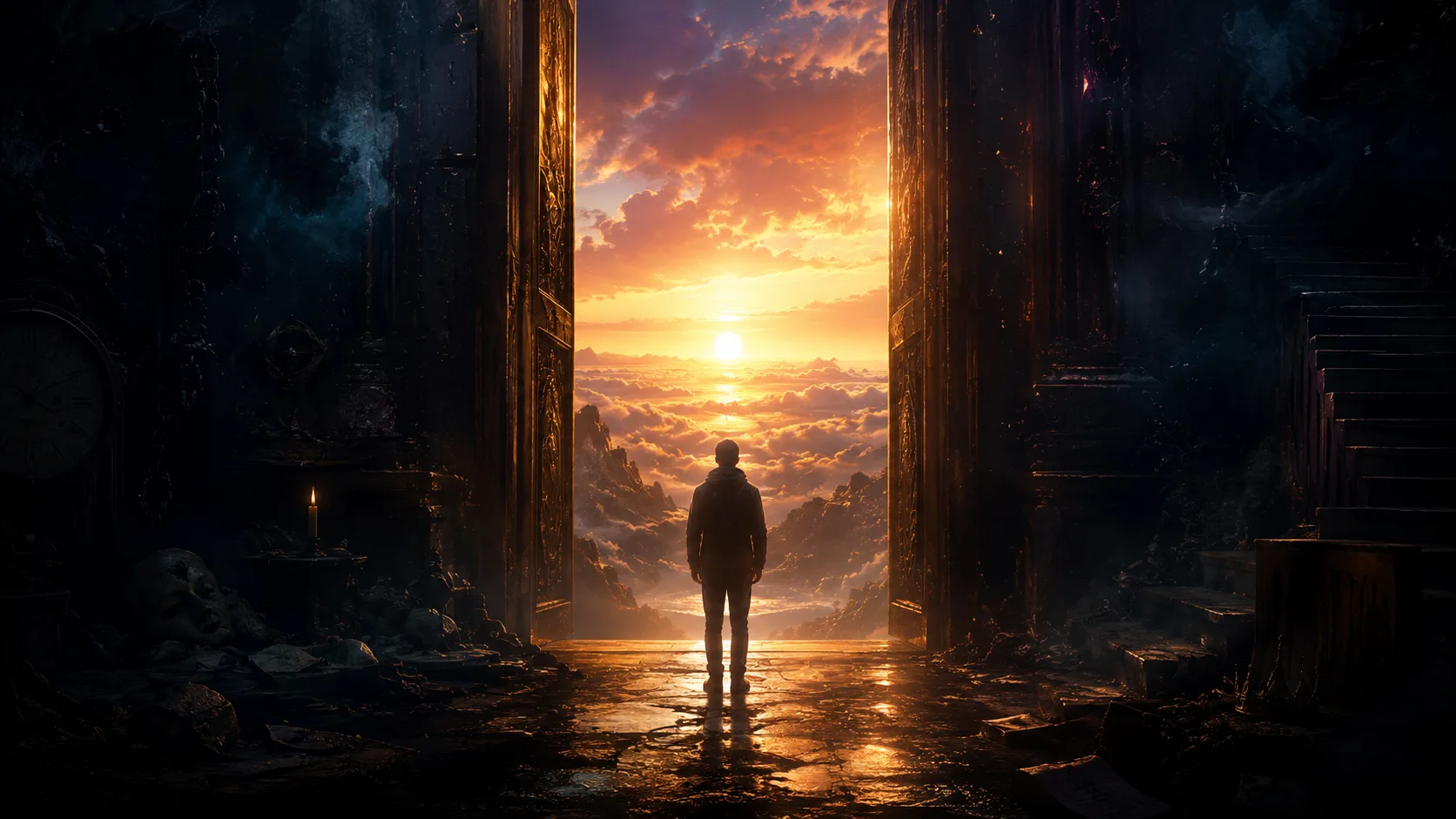
Life Is Not About Life
A deep reflection on death, suffering, meaning, and why life may not be the final subject of existence — but the pressure through which the self is forced to awaken.
One day, everything you are fighting for will stop mattering in the way it matters to you now.
The money you are chasing, the fear that is consuming you, the problem that feels larger than your breath, the success you think will finally explain you, the person you are afraid to lose, the image you are trying to protect — all of it will change size the moment you remember one thing:
Life is not about life.
This is not a sentence meant to comfort you quickly. It may disturb you first. It may insult the part of you that is still negotiating with life, still asking it to become fair, still waiting for it to behave according to the shape of your desire.
But perhaps a sentence that does not disturb us at all is not yet deep enough.
We wake up inside life and immediately forget that we are inside it. We work, worry, love, lose, wait, pray, fail, succeed, suffer, and hope. We build homes. We defend our names. We chase money. We carry dreams. We fear humiliation. We fear poverty. We fear disease. We fear being forgotten.
Then, suddenly, a person dies.
A person who yesterday was full of plans becomes a memory. A voice becomes silence. A face becomes a photograph. A body that carried ambition, pride, faith, anger, desire, shame, love, and unfinished thoughts is removed from the visible scene in one moment.
And we continue.
We drink coffee. We answer emails. We pay bills. We return to traffic. We speak about tomorrow as if tomorrow has signed a contract with us.
Is this not strange?
If life were only about life, death would make life unbearable.
If life were only about comfort, death would be an insult.
If life were only about success, suffering would be proof of failure.
If life were only about getting what we want, every unanswered prayer would become evidence that we have been abandoned.
But perhaps the problem is not life.
Perhaps the problem is that we stand inside the visible part of life and mistake it for the whole of existence.
A man standing inside a room cannot judge the size of the house.
A human being standing inside one moment cannot judge the meaning of existence.
Yet this is what we do every day. We stand inside a problem and call it the world. We stand inside pain and call it truth. We stand inside fear and call it reality. We stand inside a wound and begin to build a religion around it.
The mind is not innocent in this matter.
The mind wants a story. It wants a villain. It wants an explanation it can hold. It wants to say, “This happened because of that.” It wants to reduce the unbearable mystery of existence into a sentence small enough to control.
But life is rarely small enough to obey the mind.
The mind sees through fear, memory, desire, shame, and old wounds. It does not see life purely. It colors life with itself, then forgets that it has done so.
This is why the life inside your head is not always the same as the life outside your head.
Your problem may exist in the world, yes. Your grief may be real. Your loss may be real. Your pressure may be real. But the prison is often built by the story your mind adds after the event.
The event hurts.
The story imprisons.
When you are trapped inside a crisis, the crisis becomes enormous. It becomes the ceiling above you, the ground beneath you, the walls around you. It becomes the only shape your mind can recognize.
But the moment you step back inwardly, something changes.
Not the problem.
Not the pain.
Not the uncertainty.
You change.
Or more precisely, your position changes.
You stop standing inside the mouth of the problem. You begin to see it from somewhere deeper than panic.
And from there, the problem loses its claim to be everything.
This is not positivity.
This is not decoration.
This is not the cheap wisdom that tells a wounded person to smile while bleeding.
Pain is pain. Loss is loss. Fear is fear. A wound does not become beautiful because someone found poetic language for it.
But there is a difference between respecting pain and kneeling before it.
There is a difference between saying, “I am in pain,” and saying, “I am nothing but pain.”
The first sentence is human.
The second is captivity.
Perhaps life becomes unbearable when we forget that what happens inside the scene is not the whole scene.
The body is in the scene.
The job is in the scene.
The money is in the scene.
The illness is in the scene.
The loss is in the scene.
Even death, from where we stand, appears inside the scene.
But existence is larger than the scene.
And here begins the dangerous question:
What if life is not the final thing?
What if life is a passage?
What if life is a school, but not the childish kind that rewards you for memorizing the right answer?
What if life is a school that teaches by pressure, contradiction, silence, delay, loss, love, humiliation, longing, and the unbearable fact that you do not control as much as you pretend?
What if life is a mirror, not because it shows you your face, but because it shows you the faces you hide from yourself?
What if life is not here to flatter you?
What if life is here to reveal you?
This is why suffering is so difficult to understand. We often ask suffering to justify itself immediately. We want pain to present its documents. We want loss to explain its purpose. We want God, fate, the universe, or life itself to stand before us and answer according to the limits of our heartbreak.
But maybe the first violence we commit against existence is that we demand it to fit inside our emotional timing.
We want the answer now.
We want relief now.
We want meaning before the wound has even finished opening.
Yet some meanings are not given to the person who is merely asking.
Some meanings are given only to the person who is becoming.
And becoming is rarely gentle.
It removes illusions before it gives wisdom. It humiliates arrogance before it gives clarity. It shows us our weakness before it lets us speak about strength.
Maybe this is why life cannot be reduced to comfort. Comfort may calm the body, but it does not always awaken the soul. Success may decorate the name, but it does not always reveal the self. Money may protect the surface, but it cannot answer the question that waits in the dark when no one is watching.
Who are you when nothing obeys you?
Who are you when your plan collapses?
Who are you when your prayer is not answered in the way you demanded?
Who are you when the life in front of you refuses to become the life you imagined?
This is where life begins to expose us.
Not to destroy us.
To expose us.
To show us the difference between faith and habit, between strength and performance, between patience and numbness, between love and attachment, between truth and the story we created so we could survive.
There is a moment when the human being must stop asking only, “Why is this happening to me?”
This question is natural. It is not wrong. It is the cry of the wounded mind.
But if we remain there forever, the question becomes a cage.
A deeper question waits behind it:
What is this asking me to become?
Not what is this giving me?
Not what is this taking from me?
Not who should I blame?
But what is this revealing?
What is this pressure exposing in me?
What is this loss teaching me about the shape of my attachment?
What is this fear showing me about the weakness of my trust?
What is this delay showing me about the violence of my impatience?
What is this silence showing me about the noise I used to hide behind?
When the question changes, the journey changes.
Perhaps the first question is not, “Why was I created?”
That question may be too large for the human mind. It can lead us into anger, arrogance, and confusion, because it asks for the hidden intention of the Creator, the final architecture of existence, the secret behind the whole design.
Maybe that question is not the door we are meant to open first.
Maybe the more honest question is:
I am here now — what should I do with this existence?
This question begins from humility.
I am here.
I do not know everything.
I did not choose the beginning.
I do not control the ending.
I do not see the whole design.
But between the beginning and the ending, something has been placed in my hands.
My awareness.
My choices.
My response.
My ability to observe.
My ability to rise above the first reaction.
My ability to stop turning every wound into an identity.
My ability to ask what life is revealing through me.
This is where the journey becomes serious.
Not serious in the way the world understands seriousness. Not titles, achievements, status, applause, or the illusion of importance.
Serious in the quiet sense.
The terrifying sense.
The beautiful sense.
The sense of becoming responsible for your own consciousness.
Work, but do not become only your work.
Love, but do not disappear inside attachment.
Suffer, but do not worship suffering as if it is your god.
Succeed, but do not believe success has explained you.
Fail, but do not believe failure has named you.
Pray, but do not turn prayer into a contract where God must obey your preferred ending.
Search, but do not claim you have captured the whole truth simply because your mind has become comfortable with one version of it.
Live fully, but remember that life is not the full size of existence.
Life, as we see it, may be only a visible surface over an unseen depth.
A doorway.
A passage.
A mirror.
A pressure.
A question.
A temporary field where the soul, the mind, the body, the wound, the prayer, the fear, the love, and the unknown meet.
And perhaps the point is not to solve life as if it were a puzzle.
Perhaps the point is to become more awake inside it.
So when life becomes narrow, step back.
When pressure rises, step back.
When the mind says, “This is everything,” step back.
Look again.
There is the event.
There is your mind’s story about the event.
And there is you — the one who can observe both.
From that place, life becomes smaller.
Not meaningless.
Smaller.
And the self becomes wider.
Not arrogant.
Wider.
Perhaps this is the beginning of wisdom: to live inside life without being completely deceived by it.
To suffer without becoming only suffering.
To search without pretending you have captured the whole truth.
To stand inside the temporary while remembering that existence may be greater than everything you can see.
One day, everything you are fighting for will stop mattering in the way it matters to you now.
But what life awakened in you may remain.
What it exposed may remain.
What it purified may remain.
What it forced you to see may remain.
What it made you become may remain.
Life is not about life.
Life is about what life reveals in you.
The cruelest prison is not suffering. It is believing that suffering is the whole of life.
How did this make you feel?
Tap a sentiment to echo your reflection through this piece.
Continue the Journey
Go back to the full Journey page to explore more reflections, stories behind the songs, and writings from the books.
Back to The Journey
Leave Your Reflection
Share a thought, a memory, or a feeling this piece awakened in you.