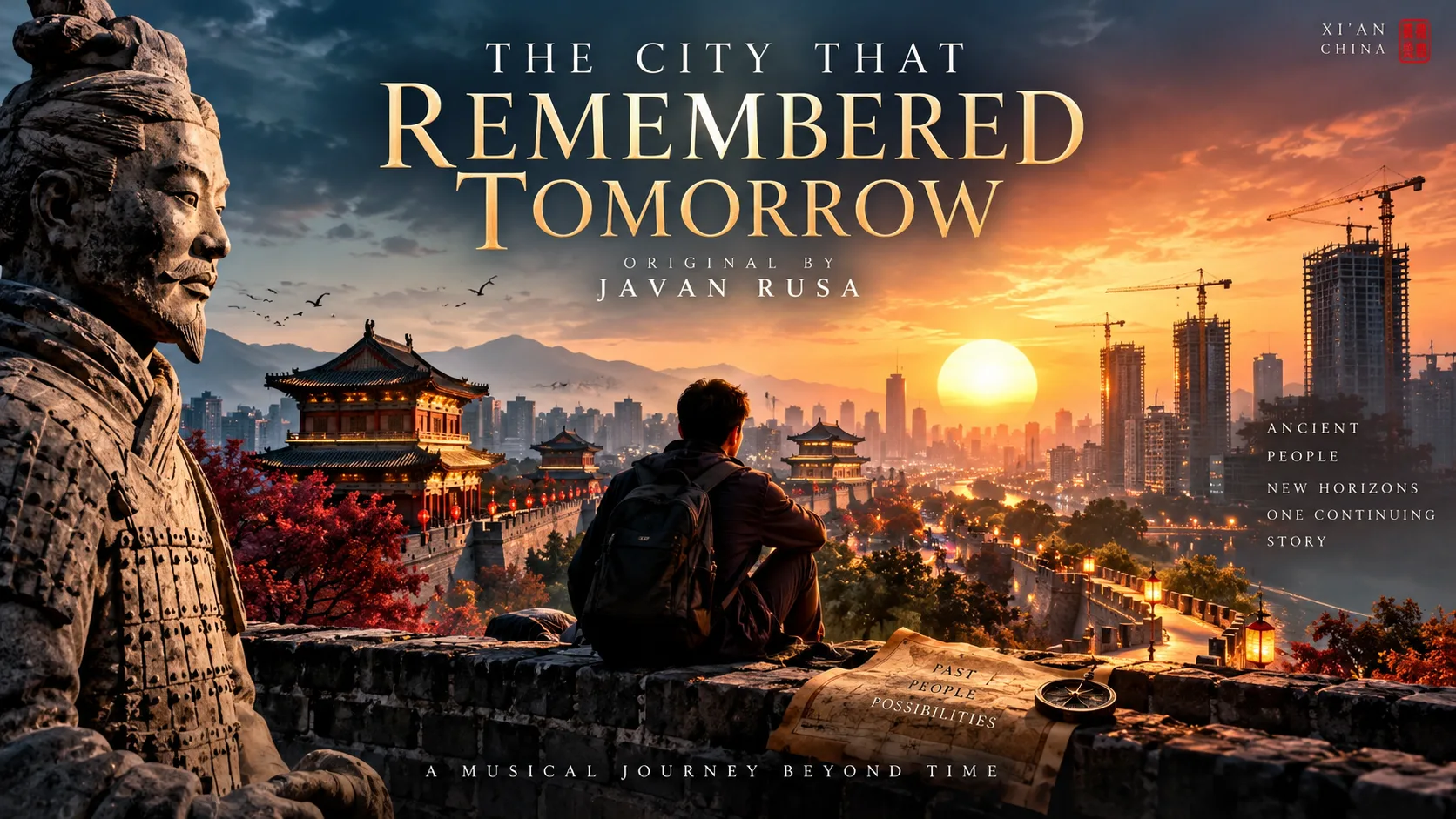
The City That Remembered Tomorrow — What Xi’an Taught Me About Time
I travelled to Xi’an expecting to visit a company. I returned thinking about time, what we inherit from those before us, what we leave for those after us, and why perhaps the deepest meaning of building has very little to do with buildings.
I travelled to Xi’an expecting to visit a company.
I returned thinking about time.
That was not what I expected from the journey.
I expected meetings, projects, unfamiliar streets, photographs, history, perhaps a few memories to bring home.
Instead, Xi’an left me with a question:
A City That Makes Time Visible
There are places where history is something you read.
And there are places where history seems to stand beside you.
Xi’an felt like the second.
You can stand before something created centuries before your birth and realize that the hands that made it are gone.
Their conversations are gone.
Their worries are gone.
The deadlines that once seemed urgent, the disagreements that once felt important, the ordinary mornings they assumed would keep returning...
all gone.
And yet something they touched remains.
Then you turn around.
The city is alive.
People are working. Buildings are rising. Ideas are becoming drawings. Drawings are becoming structures. Structures are becoming part of a city that another generation may one day call history.
And somewhere between what has survived and what is still being created, you begin to understand how brief our own turn really is.
We Arrive in the Middle
None of us began this story.
And none of us will see its final page.
We arrive somewhere in the middle.
We inherit roads we did not pave, knowledge we did not discover, cities we did not begin, and a world shaped by people whose names we may never know.
For a little while, some part of it is placed in our hands.
We work.
We change things.
We build.
And eventually, we leave it for people we may never meet.
Perhaps this is why building has always meant more to me than buildings.
A building may be concrete, steel, glass and stone.
But behind those materials are pieces of human life.
Someone imagined it.
Someone drew it.
Someone calculated it.
Someone argued over a detail that nobody else would ever notice.
Someone made a mistake.
Someone stayed late to solve it.
Someone stood beneath the sun and built it with their hands.
And eventually the building remains...
while most of those moments disappear.
The Future Rarely Looks Like the Future
My journey to Xi’an was not only an encounter with history.
I had travelled there through SCEGC, to visit our headquarters, see projects, meet colleagues and understand more closely the work being created in China today.
And that produced an unexpected contrast.
I was standing among evidence of what previous generations had built while surrounded by people building what future generations may inherit.
That was when something became clear to me:
The future does not arrive one morning already completed.
Someone is drawing it today.
Someone is calculating it.
Someone is pouring its concrete.
Someone is solving the problem nobody outside the room will ever know existed.
History probably looked ordinary while it was happening too.
Perhaps that is one of the strange things about being alive:
we rarely know which ordinary day will eventually become part of something much larger than us.
So I Tried to Say It Without Words
After returning home, the feeling stayed with me.
I could explain the journey.
I could show photographs.
I could describe the places I visited.
But none of those things quite expressed what Xi’an had left inside me.
So I turned to music.
I called the piece:
The City That Remembered Tomorrow
The music begins with something that feels distant, almost ancient.
A small motif appears.
It disappears.
It returns differently.
Then slowly, the sound begins moving toward something new.
The past is not erased.
It becomes part of what comes next.
That mattered to me.
I did not want to create music simply “about ancient China.”
Nor did I want to create music simply “about modern China.”
I wanted to capture the moment when I felt both at the same time:
the enormous weight of what has already happened...
and the possibility of everything that has not happened yet.
Perhaps That Is What a City Really Is
We often think of a city as buildings, streets and people.
Perhaps a city is something more.
Perhaps it is a conversation between generations that can never meet.
One generation leaves something behind.
Another receives it.
Changes it.
Adds something.
And passes it forward.
The conversation continues even though the speakers keep disappearing.
Xi’an made me feel that conversation.
And perhaps that is why the city remained with me after I left.
Our Turn
Eventually, every project finishes.
Every meeting ends.
Every drawing becomes old.
Every problem that once seemed enormous becomes a story somebody barely remembers.
And eventually, our turn ends too.
But somewhere...
someone walks through a door.
Someone crosses a bridge.
Someone looks out from a window.
Someone lives inside something another human being once stayed late trying to get right.
They may never know our names.
Perhaps they do not need to.
For a little while, it was simply our turn to build.
And then...
tomorrow remembered us.
The City That Remembered Tomorrow An original instrumental composition by Javan Rusa Inspired by Xi’an, China
© 2026 Javan Rusa. All Rights Reserved.
We do not build because things last forever. We build because we don't.
How did this make you feel?
Tap a sentiment to echo your reflection through this piece.
Continue the Journey
Go back to the full Journey page to explore more reflections, stories behind the songs, and writings from the books.
Back to The Journey
Leave Your Reflection
Share a thought, a memory, or a feeling this piece awakened in you.